The Myth of ‘Gay Community’?
By Alex Hopkins
Beige Magazine, Autumn 2013 issue
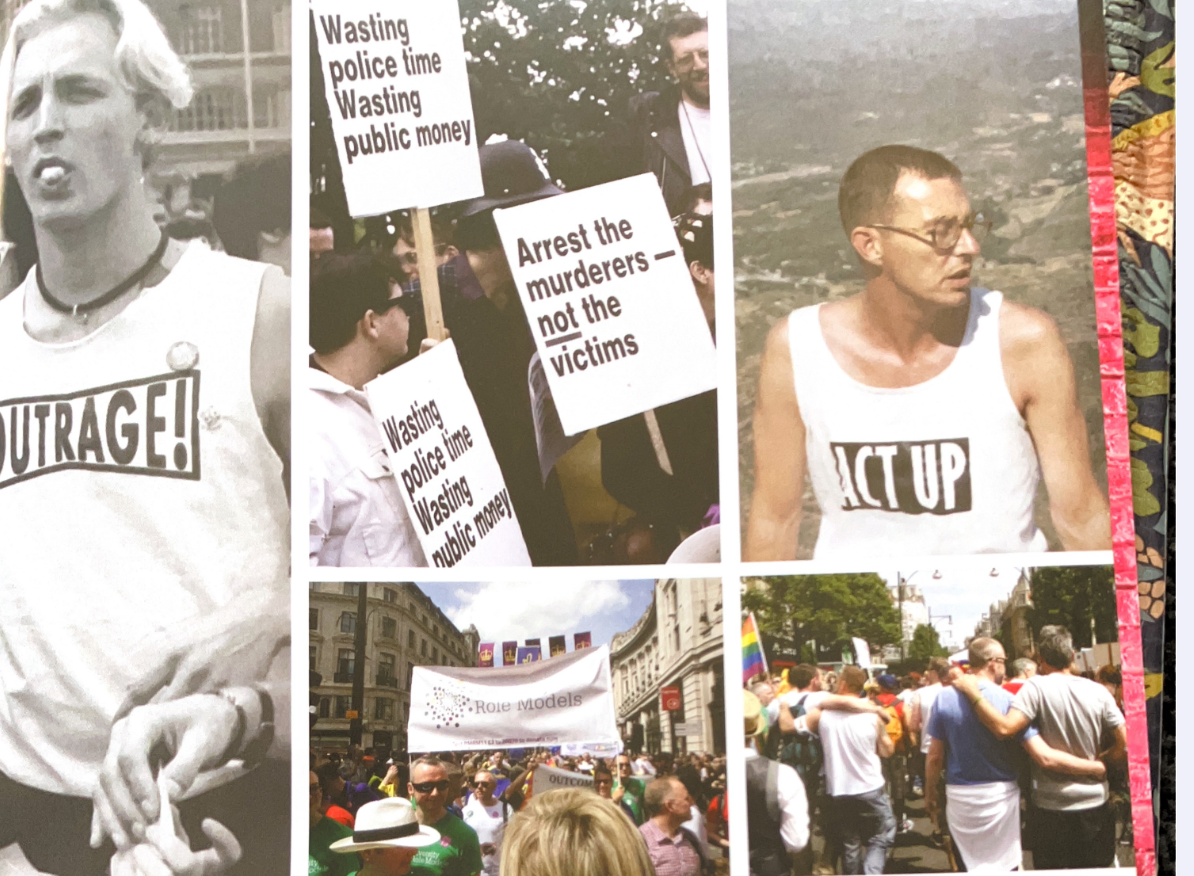
It started as an innocent question on Facebook: ‘Is there a gay community in London?’ My wall, which, like many, I’ve come to regard as a type of community in itself – somewhere I got to share, vent, or for the odd bit of shameless attention – was soon inundated with responses.
The comments varied, a discussion started and grew heated; definitions were bandied about, alternative words used, the forgotten art of communication lamented, and there was a sense of nostalgia for something that LGBT+ people had lost or, depending on the viewpoint, never possessed.
As I write this piece, I'm conscious – more so than usual – of the language I use. Even pronouns are problematic – will people be offended when I use ‘we’, thereby clumping diverse groups together? When a ‘community’ consists of so many different types of people, based on class, race, and gender, just using the word ‘we’ can feel strange. To what extent do we share values and a genuine sense of connection? Buoyed by my early explorations on Facebook, I set out in search of answers.
I began by looking at definitions of ‘community’. Andy Medhurst, a senior lecturer in media, film and cultural studies at The University of Sussex, says, ‘at its broadest, community is a group of people connected in some way that gives meaning and significance to their lives. A community can be forged on the basis of geography, ethnicity, class, culture, shared beliefs, and interests.
‘As such, it can have real importance, as a way of sustaining and strengthening identity and forming a rallying point against prejudice or discrimination.’ But, warns Medhurst, ‘it is such a loose, baggy word it can lose impact and grow very fuzzy. At its worst, it becomes just another word used to denote individuals with similar interests. I saw one reference to the chess-playing community,’ he jests.
In which case, I wonder, do the only common interests gay men share come down to merely the business of searching for sex?
‘I think the diversity of modern gay lives makes the word “community” more and more meaningless,’ says Medhurst. ‘Community in the singular seems increasingly impossible to maintain beyond that very obvious and frankly banal link of shared sexual desires. I mean, what community could connect David Starkey and Rylan Clark?’
To me, community has always meant a feeling of belonging and friendship – what I craved when I came out as a spotty, bullied eighteen-year-old. Sixteen years later, I sometimes wonder if this was more of a Utopian fantasy than a reality. Am I already that jaded? Yet, certainly, even over the course of my ‘out’ gay life, community in that traditional sense has changed hugely. I’m old enough to remember using an internet cafe to access Gaydar, over a decade before Grindr revolutionised the way gay men interact. Changes in the law and increased mainstream acceptance of LGBT+ people have also reshaped the idea of a ‘gay community’. Does Medhurst think that there was more of a community when gay people had fewer rights – indeed, has winning equal legal rights diminished a community mentality?
‘To some extent, yes. When there were more equal rights struggles to fight for, the sense of common purpose and shared aims was more tangible and focused. That’s not to say equality is universal or secure, of course, and vigilance is always required.’
Medhurst’s warning echoes the words of Peter Tatchell – ‘the price of queer freedom is eternal vigilance’ – and makes me wonder how effectively, given the fragmentation of the LGBT+ community, we would be at responding to any systematic, government-led anti-LGBT+ tyranny – the sort that we’re now seeing in Russia. Would we be able to galvanise our strength in the same way as we did during the Aids epidemic – arguably the time when notions of community were at their strongest?
‘I don’t think that community in the old singular sense holds much water now,’ concludes Medhurst, ‘except paradoxically when homophobic threats or attacks need to be faced. Threats from others with very fixed and inflexible ideas about sexuality need to be confronted in a united way.’
Simon Watney is one the gay activists who set up OutRage!, along with Chris Woods and Keith Alcorn. During the 1980s, he also worked extensively in the U.S. with ACT UP. ‘I think community was always an ideal somewhere in the future to be established,’ he reflects. ‘Perhaps it was easier in the 70s and 80s to talk more casually about it, but that was for reasons very specific to the period – everyone shared discrimination of a very acute kind, no matter how much they differed in terms of the social disparities between men and women, class and race. Everyone knew that there was the law bearing down on us – the police were hideous – as were most schools, the radio, and newspapers. Even before the Aids epidemic came along, we were united in our response to something that was vile and deeply unjust.’
Yet, like Medhurst, Watney is conscious that ideas of ‘gay community’ are very different today. ‘I can see why you would want to put the word in inverted commas,’ he says with a smile. ‘Kids coming out today haven’t grown up with the same levels of discrimination. I wouldn’t want to downplay the prejudice that still exists in families and elsewhere in the country, but it is not on the same scale as the social illegitimisation back then.’ He reiterates Medhurst’s point about sexual desire perhaps being the only thing we now have in common – ‘a fragile ground.’
During the fight against Margaret Thatcher’s Section 28 and the devastation wrought by the Aids epidemic, Watney saw LGBT people unite with a shared purpose. ‘I think community gets reforged and reinvented at times like that,’ he says.
‘But my main point is that people can diss the whole idea of community quite easily as this silly delusion, and they always have – and they are being quite rationalistic, because the things we’ve touched upon, that level of prejudice that brought people together with such force, are not entirely unimportant – they connect us.
‘Now we see the atomisation of gay men, especially younger gay men, and the fact that they take things for granted that my generation couldn’t. But who can blame them? I would be mad to think that someone coming on to the scene today could understand what it was like 20 years ago. Why the hell should they? How the hell could they? Who is going to tell them? There is no easy access to finding these things out.’
Does Watney believe the lack of gay role models also plays a part here?
‘‘Absolutely. The danger is we only have very few people in the public arena who talk about the issues we’re talking about here – Peter Tatchell, Ian McKellen, and Stephen Fry. They’re all virtuous, admirable people, but the idea that a very substantial social constituency is represented by only three people seems to me laughable and a sign that something is wrong. But this atomisation is not unique to just gay men and lesbians – it affects everyone. The technology for making connections is great, but in spite of that, people tend to be as isolated, if not more isolated, than they ever were.’
As Simon Watney leaves, I instinctively reach for my phone to check Facebook and emails. Like many other gay men in London, I also have the Grindr app, and while I’ve frequently lamented the disrespectful ease with which you can dismiss a potential partner online, I too have pressed that red ‘block’ button. At times it seems that the gay community today has been reduced to little more than a throwaway online supermarket full of digital ‘favourities’ many of us never meet, let alone forge a genuine connection with.
Simon Harrison is the lead tenor of The Pink Singers, Europe’s largest running ‘LGBT community choir’. The group was formed around the same time that Simon Watney and OutRage! were challenging Section 28. Harrison is in his early 50s and joined the choir five years ago. I’m particularly interested in this musical social group because its members range from age 20 to 60 and represent a broad cross-section of backgrounds.
‘I definitely belong to a community now, and I didn’t come out until I was 29,’ Harrison tells me. ‘Back then, things like Pride events were important to me, as was going to gay pubs, but it wasn’t that I then linked in with lots of people – the choir is all about relationships in a way that I hadn’t really experienced in terms of gay community before.’ Like many people, Harrison uses the words ‘gay community’ almost instinctively, but does he believe one exists and, if so, what does it mean to him?
‘You know, I don’t think there is a gay community,’ he says with a sigh. ‘But we’re united by some shared experiences – oppression and shame. So you go to an event like Pride and there’s a huge sense of relief that we can be in a place where we don’t feel we stand out. It’s almost about invisibility – being able to blend in.’
What impressions does Harrison have about how the younger people in the choir participate in community types of behaviour?
‘There seems to be less pressure on them – they are less hidden now in society, so there’s less need for them to create the kind of niche type of communities we had more of in the past – like bears and twinks and those kind of stereotypes. They seem to find it easier to move between different communities – and the straight community...whatever that is.
How does he think this affects their need for exclusively gay spaces?
‘I think it’s less pressing – having said that, we recently had an exhibition at King’s Place in which young people were invited to add Vox Pops on their experiences, and you still hear people in their twenties saying they feel like aliens at work. One gay man of 22 stood up at a rehearsal and thanked the choir for giving him a reason to come out to his parents. We’re an invaluable support to these young people, and I find it very moving to be a part of that.’
I bring our conversation back to the idea of shared ‘shame’, which both Simon Harrison and Simon Watney have alluded to. It seems to me that while the arguably more cohesive sense of community of the past may now have fragmented as we’ve won legal rights and mainstream acceptance, the one thing that remains is the deep-seated feelings of worthlessness that many share.
‘I think it’s still there and may have gone underground a bit,’ says Harrison. ‘There’s a veneer of acceptance today, and it’s not all a veneer – some of it is very real, but it’s happened very quickly: we’ve won more rights faster than any other civil rights movement, and I think the trauma of stigma is still reverberating. I guess that’s one of the reasons that there’s so much self-destructive behaviour among gay people – unsafe sex or use of drugs and drink. The great thing about the choir is that it’s a community that isn’t intent on getting “out of it” - it isn’t focussed around getting trashed but on creating something, and that’s really powerful, especially as gay people are often seen as creative dead ends because historically we haven’t had children.’
These ideas of gay shame and its ramifications have formed the centre of Ade Adeniji’s work since 2011. With fellow life coach, Darren Brady, he set up The Quest, a weekend exploration workshop where they trace the lives of participants as gay children through adolescence and adulthood, investigating the experiences that have shaped who they are today and helping them cultivate the insights to live, what Adeniji calls, ‘a life of authentic self-expression.’
‘Community can be such a loaded word as it comes filled with many perceptions and expectations,’ says Adeniji. ‘At a very basic level, it has come to mean a group of people with a shared identity – so we hear people talk about the “black community’, ‘disabled community’ or ‘LGBT community’. Sadly, in those cases, it is often “community” at a very surface level. When I think of community, I think of a process much deeper than a shared identity; to me it also means a group who feel a sense of connection, combined with a degree of shared values; a group where there is a sense of responsibility and caring for others.’ Does he feel such a group exists in London today?
‘I think we have a community of gay men with a shared identity in terms of sexual attraction, but that’s as far as it goes. I don’t feel that there is a sense of shared values, connection, or even compassion for one another amongst many gay men. Sadly this is echoed by many of the men I have spoken with through The Quest. The most common theme that has emerged is the longing to connect in a non-sexual way and away from the scene. I interpret this as a longing for community.
Like Simon Watney, Adeniji believes there has been more of a community feel in times of greater social oppression. He compares it to how people come together after a world disaster and mentions ‘nourishing and nurturing’ behaviours. Healing the emotional wounds of the past is vital for gay men, he says.
‘One of the problems is that I don’t think there has been a time when we as a “gay community” have sat down collectively to explore what community really means – away from the gay scene and Pride, away from the political rallies and calls for social justice.’
Perhaps the next challenge is finding the right forums to have that kind of discussion.